At the jubilee 30th Croatian Minorities Forum that took place in the Croatian Heritage Foundation, libraries and social networks turned out to be two sides of the same story – the story about the survival of language, identity and communities in 12 European countries
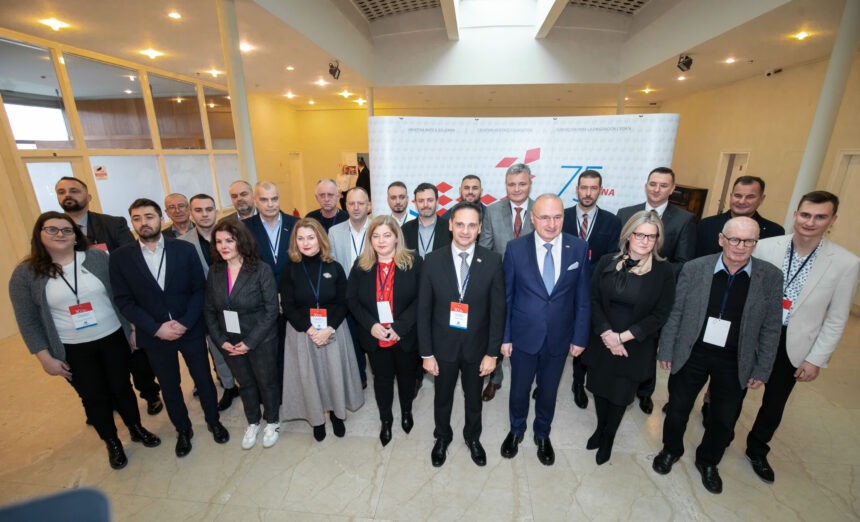
On December 5, 2025, the jubilee 30th Croatian Minorities Forum, organized by the Croatian Heritage Foundation, was held, traditionally gathering representatives of Croatian minority communities from 12 European countries, experts, researchers and representatives of Croatian state institutions. This year’s Forum, dedicated to the topic of “Libraries and Social Networks of the Croatian Minorities in the European Neighborhood”, demonstrated how the identity, language and cultural heritage of Croatian minorities are maintained and developed during a period of increasingly strong digitization.

The participants were greeted in the crowded, large hall of the Croatian Heritage Foundation by CHF Director Zdeslav Milas, M.Sc., who emphasized:
“In recent years, we have witnessed significant changes in the ways in which people – especially pupils and students – consume written content, which is, above all, reflected among young generations growing up in a digital environment. The mission of this Forum is to identify the challenges and to showcase the achievements of Croatian minorities in the culture of reading and librarianship in the digital age, and to come up with new profiles of contemporary libraries in the Croatian minority communities – dispersed in the 12 surrounding countries of the multilingual European neighborhood. It is our desire for today’s encounter, through dialogue and ideas, to come up with guidelines in the form of conclusions for the best possible affirmation of new forms of reading and librarianship as an integral part of the contemporary Croatian cultural unity.”
The jubilee Forum was enhanced by numerous high-ranking guests – the Minister of Foreign and European Affairs of the Republic of Croatia, Dr. Gordan Grlić Radman, Envoy of the Speaker of the Croatian Parliament and President of the Parliamentary Committee for Croats Abroad Zdravka Bušić, President of the Government Council for Croats Abroad and President of the Croatian Self-Governing Body in Hungary Ivan Gugan, Member of the Croatian Parliament and President of the Croatian National Council in the Republic of Serbia Jasna Vojnić, Envoy of the State Secretary of the Central State Office for Croats Abroad Zvonko Milas, Vedran Iskra, National Director of Pastoral Care for Croats Abroad, Fr. Tomislav Markić, and Mate Granić, Special Advisor to the Prime Minister for Foreign Policy. “Communication and collaboration, learning and cultural creation are increasingly moving into this space of digital libraries, providing cultural institutions a new expanded role – not only as guardians of heritage, but as a stable bridge towards future generations. The Croatian Government recognizes these needs and supports activities that ensure accessibility to Croatian culture, language and history in contemporary forms. Digitization, social networks and new technologies are not in competition with tradition, they are just an occasion and an opportunity for our people, regardless of where they live, to have access to content connecting them to their roots,” said Minister Grlić-Radman.


NUMEROUS REPRESENTATIVES OF THE DIPLOMATIC CORPS
The Forum was attended by the ambassadors of Austria, Montenegro, Czechia, Kosovo and Slovakia to the Republic of Croatia – their Excellencies Yvonne Tončić Sorinj, Dejan Vuković, Milan Hovorka, Martin Berishaj, Hana Kovačova, on behalf of the Hungarian Embassy Consul General Radován Rusz and Envoy of the Ambassador of Slovenia Tamara Palanka, and also arriving in Zagreb were representatives of the diplomatic corps of the Republic of Croatia in Kosovo, Hungary, Macedonia, Romania, Slovakia and Slovenia – their Excellencies Danijela Barišić, Mladen Andrlić, Nives Tiganj, Marija Kapitanović, Aleksandar Heina, Boris Grigić and Consul General in Subotica Velimir Pleša.

In their statements, they pointed out that the Forum is today a crucial platform for the interconnection of Croatian minority communities, as well as for the creation of policies that contribute to their preservation.
“The Croatian Minorities Forum is an event that has been a space of dialogue, cooperation and joint reflection on the position and role of minority communities for three decades already. In these times of significant demographic and social challenges, the Forum acquires additional importance because it enables the exchange of ideas and mutual steps forward,” said Vedran Iskra in his address.

LANGUAGE AS A FOUNDATION OF IDENTITY
The introductory presentations focused attention on language as the underlying thread of the entire gathering. Domagoj Vidović, Ph.D. from the Croatian Language Institute reminded us that Croatian history could be summed up by the catchphrase “unity in diversity” – and it was precisely language that united Croats, even when stateless. The language lives on today in different variants: in the Burgenland-Croatian literary language, in the Molise dialects, which are experiencing a poetic renaissance, in the Croatian communities in Montenegro and Serbia that are facing both language assimilation and negation.

Silvestar Balić, Ph.D., from the Scientific Institute of Croats in Hungary, analyzed the continuity of the Croatian printed word in Hungary, recalling that major works of Croatian culture were created in that area, which today is often not perceived as belonging to the Croatian cultural area. “Croatian publishing in Hungary is not just a footnote, but an important thread in the overall network of Croatian written heritage,” he emphasized.

HERITAGE, HOMELAND AND NEW TECHNOLOGIES
The first panel of the professional program was dedicated to the role of libraries in Croatian minority communities, which have been the fundamental guardians of language, books, and cultural memory throughout history, and today are transforming into hybrid places of knowledge – both physical and digital. Moderated by Tatjana Rau, the panel opened a discussion on the power of libraries as spaces of identity, knowledge, and gathering.

Acting Director of the Institute for the Culture of Vojvodina Croats, Josip Bako, presented the project of the Biblioteca Croatica Heritage Library, which combines traditional collections with digitized content and the Heritage of the Croats in Serbia collection. Ana Vuksanović from Montenegro drew attention to the fact that minority libraries today bear a double responsibility: preservation of heritage and active measures against assimilation, especially in a digital environment that is changing how knowledge is accessed.


From Slovakia, Jive Maász presented his unique collection of old Croatian books and prayers from Čunovo – a unique private museum that bears witness to the development of the Burgenland-Croatian language. From Slovenia, Koraljka Čeh presented the “book corners” model in Croatian associations, which have grown from spontaneous initiatives into local cultural centers. Sofija Klarin Zadravec, Ph.D., Assistant Director General of the National and University Library (NUL) in Zagreb, presented how the NUL is building and digitally unifying the Croatica collection, emphasizing the importance of also including the foreign Croatica into the national corpus.

From an anthropological perspective, Prof. Marijeta Rajković Iveta, Ph.D. from the Department of Ethnology and Cultural Anthropology at the Faculty of Humanities and Social Sciences, University of Zagreb and head of the Department of Migration and Minority Communities presented minority libraries as multifunctional community spaces, and Vlatko Smiljanić, Ph.D., Associate Professor, from the Department of Croatian Language and Culture at the Faculty of Croatian Studies offered a Croatian language and culture model of understanding heritage as a dynamic category of identity.

Đuro Vidmarović provided his opinion on the importance of digitizing literary works, which implies the cooperation of Croatian institutions in this endeavor. He also pointed out that digitization does not only imply literature, but also various documents that are important for the history of Croatians in a certain area.


In the discussion, Andrija Handler, Ph.D., Director of the Collection of Sacral Art of Croats in Hungary, said that the Croatian Cultural Association in Burgenland has launched a project for a joint library system for Burgenland Croats in all three countries. And Ivan Dobra, Editor-in-Chief of the newspaper Hrvatska Graničica, spoke about the life of the Karaševo Croats. Darko Perić, Vice President of the Croatian National Council of Montenegro, spoke about the truly important role of the Ljudevit Gaj Library, located in the local Cultural Center in Donja Lastva, and which has come under the administration of the Republic of Croatia after years of diplomatic efforts by Croatian diplomacy.


VIRTUAL COMMUNITY ARCHIVES
The second part of the Forum was dedicated to social networks, which today, as was highlighted, function as new virtual libraries — places where memories are stored, activities are documented, language is transmitted, and dispersed community members are connected.

Moderated by Katarina Jelić, the panel focused on the perspective of digital platforms as new places for gathering, documenting, and sharing identities – especially among young people.

Robert Hajszan, Ph.D., President of the Pannonian Institute in Austria and “distributor” of the online edition of the publication Panonski LIST, spoke about the development of literacy among Burgenland Croats, emphasizing the role of modern digital tools in presenting historical texts and promoting the Burgenland-Croatian language, Timea Šakan Škrlin, Director of the publishing house Croatica d.o.o., presented Croatica’s extensive digital system – a website, a YouTube channel, and Facebook and Instagram platforms that inform, archive, and connect the Croatian community in Hungary.


From Italy, Francesca Sammartino, President of the Agostina Piccoli Foundation, member of the KroaTarantata association and editor of the online radio station Čujemo se, presented how the Molise Croatian community – once isolated in terms of communication – is today managing to revive its language, music and customs through platforms such as RIČ ŽIVA, the online radio station Čujemo se and social networks. Tereza Grandić, Editor-in-Chief of Hrvatske novine from Burgenland, Austria, spoke about the challenges and opportunities of minority journalism in the era of social networks. She emphasized that the daily activities of Hrvatske novine have become intertwined with online publications and digital archiving, and that digital media enable faster visibility of events from numerous Burgenland villages and Austrian cities.

Marko Vidaček from the Macedonian-Croatian Association explained how the small but very active Croatian community in Skopje is increasingly turning to social networks to maintain visibility. He emphasized the importance of joint online projects with young people and the development of digital content connecting Macedonians and Croats.

Denis Lipozenčić from the Croatian National Council of Serbia (HNV), presenting an overview of the HNV’s digital initiatives, emphasized the importance of quality and professional content on social networks. He also pointed out that digital channels are becoming a crucial tool for working with young people, who often do not have a direct opportunity for formal education in the Croatian language in Serbia.

Associate Professor Mario Bara, Ph.D., from the Catholic University of Croatia emphasized that social networks are becoming “dynamic libraries of collective memory” – spaces in which identity is actively reconstructed and transmitted, while Vjekoslav Blazsetin from the Institute for Migration Research showed how the Instagram profiles of cultural associations spontaneously become a valuable heritage archive.


On this occasion, the Ministry of Culture and Media of the Republic of Croatia presented representatives of Croatian minorities with a large package of books co-financed by the Ministry, a valuable contribution to the enrichment of their library collections and the daily work of preserving language and culture.

The closing speech was given by Prof. Marijeta Rajković Iveta, Ph.D., who emphasized that libraries and digital platforms – although different in form – together create a contemporary identity mosaic of Croatian minorities. “It is important to encourage cooperation, networking and joint projects, so that we can preserve the depth of cultural heritage even in the digital age,” she concluded.
THE FORUM CONFIRMS ITS ROLE: COMMUNITY IN DIALOGUE, IDENTITY IN DEVELOPMENT
The Jubilee 30th Croatian Minorities Forum once again confirmed that Croatian minority communities, despite various challenges – from assimilation to demographic changes – are in constant dialogue with their homeland. Libraries and social networks have proven to be crucial bridges connecting past and future, tradition and innovation, both locally and transnationally. The Forum opened new questions and encouraged perspectives that will certainly shape future projects, research, and cooperation between Croatian minorities and institutions of the Republic of Croatia.


PROMOTION OF BOOK ABOUT THE SETTLING OF CROATS IN GRADIŠĆE
The Forum concluded with the promotion of a book about the settling of Croats in Gradišće, 450 ljet Hrvati i Hrvatice u Novom Selu (450 Years of Croatian Men and Women in Novo Selo) by Petar Tyran. Speaking about the book, consisting of more than 300 pages of large encyclopedic format, were Vesna Kukavica, Zdeslav Milas, Sara Marđetko and the author himself.
Petar Tyran is an anthologist with notable poetry reviews, a translator, and an initiator of scientific conferences. A lover of traditional culture and the most ardent advocate of Kolo Slavuj, a student ensemble cherishing Croatian heritage in Vienna. He is one of the most famous organizers of traditional events of Burgenland Croats – as is the Ball in Vienna, which has become popular with the public. He is currently an activist for the most significant fundamental educational and development project in the capital of Austria, the bilingual Croatian school, and in his fascinating work in publishing, he also holds the title of the longest-serving editor of Hrvatske novine, the weekly newspaper of Burgenland Croats from Vienna.


Text: CHF; Photo: Jurica Galoić