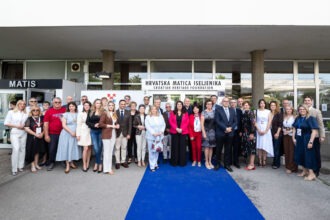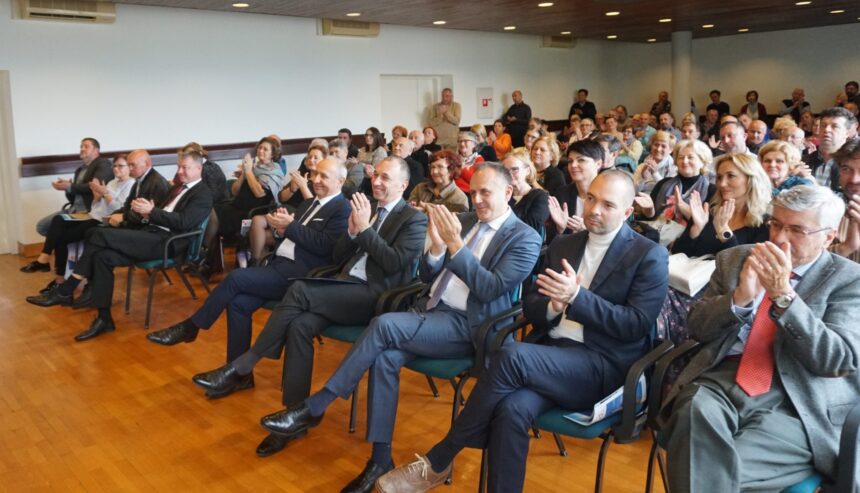
The luxurious edition was presented by editor Željko Ivanković, illustrations editor Mladenko Marijanović, and deputy president of the Vareš chapter of the HKD Napredak Croatian culture association Anto Jelić on behalf of the publisher. On hand to welcome everyone was CHF director Mijo Marić.
Vareš i vareški kraj kroz stoljeća (“Vareš and the Vareš Region Over the Centuries”) is the first ever monograph to showcase this central Bosnian town and mining region. The book was promoted at the Croatian Heritage Foundation on 14 November. On hand to present this luxurious edition were its editor Željko Ivanković, illustrations (photography) editor Mladenko Marijanović, and deputy president of the Vareš chapter of the HKD Napredak Croatian culture association Anto Jelić on behalf of the publisher. On hand to welcome everyone was CHF director Mijo Marić.
Opening the event director Marić noted that, “The writers gathered under Željko Ivanković have in this truly magnificent volume—rich in content and magical in its illustrations—opened the soul of Vareš—in joy and in trepidation, in the hope inherent to humans, as is reflected by [Ivo] Andrić when he observes that ‘people owe something to their native region.’ This book,” Marić continued, “is more than just a monograph about a region, it is also a lavish written monument to the oldest and the most recent generation of chroniclers of Vareš in all fields of human activity, from metallurgy to literature. The sixty-five sections and the inspiring epilogue describe the dominant cultural, historical and economic challenges faced by Vareš and its natural beauty.”
Joining the Zagreb audience and the many natives of Vareš in attendance were Dario Magdić, deputy state secretary at the Central State Office for Croats Abroad, attending on behalf of the prime minister, Drago Prgomet, the president of the City Council of Zagreb, Toni Biluš, attending on behalf of the mayor of Zagreb, Anto Markotić, coordinator of the Zagreb promotion, Ivan Zeba, the head of the sector for legal status, culture and education for Croats in Bosnia-Herzegovina at the Central State Office for Croats Abroad, and Čedomir Jelić, editor of the Bobovac local news bulletin of Croatians in Vareš, soon to celebrate its upcoming 300th issue.
The monograph presented over six hundred photographs and other illustrations on its almost four hundred pages, with comprehensive references and citations, and a who’s who of Vareš natives past and present compiled by Vladimir Ruf. The promotion in Zagreb, which follows on the first promotion in Vareš, was held under the auspices of the Central State Office for Croats Abroad. The event was moderated with dedication and passion by the head of our publishing department and the editor of the Croatian Emigrant Almanac Vesna Kukavica.
The first known mentions of Vareš go back 550 years, but the history of the region, notes the editor of the monograph—with Dabravine, Zvjezdangrad, Bobovac, Perun, Borovica, Duboštica, Jelaške, Oćevija and Brgule—goes back two millennia. In this one volume we find the collected efforts and insights of multiple generations of researchers such as Radimsky, Sergejevski, Kreševljaković, Filipović, Bešlagić, Basler, Anđelić, Đaković, Mikolji, Džaja, Benić, Batinić, Katzer, Ćorović, Protić, Palavestra, Zirdum, Bugarski and natives of Vareš such as Žuljić, Gavran, Tokmačić, Matić and Mlivončić. Many generations of Vareš natives have dreamt of this kind of book about their region. In the period from 1966 to 1978 the municipal authorities tried on three occasions, but without success, to publish a book of this kind. A four-year effort of the local chapter of the HKD Napredak association has finally produced this singular tome. The respectable team of editors, besides those already mentioned, included designer and art, technical and pre-press editor Mladen Divković, and text editor and revisor Jelena Jurić.
In his review writer Miljenko Jergović spoke warmly of the book, calling it precious and eminently collectable. He was, unfortunately, unable to attend the event due to prior arrangements. He further writes that this, like any other good old-time monograph, abounds with anecdotal titbits, anthropological and historical bizarreries, and exceptional and rarely seen visual material. The volume also offers a brief but very instructive overview of literature and the arts associated with Vareš and closes with a concise who’s who of eminent Vareš natives, including Franciscan friars Matija Divković and Filip Lastrić, Novak Simić, Milo Cipra, actor Boro Stjepanović, Orthodox bishop Grigorije, writer Aleksandar Kardum, and professor Mirjana Kasapović. There are a surprising number of well-known public figures with roots in Vareš. Jergović also notes that Ivanović offers a balanced view of the Vareš region as one of the Catholic areas in Bosnia, and speaks of the process of Islamisation, of the settlement of Orthodox newcomers from eastern Herzegovina and Montenegro in the wake of Eugene of Savoy’s devastation and ravaging of Bosnia in the late seventeenth century, and of the circumstances that formed the cultural and ethnic makeup we now know in the twentieth century. Jergović also noted that it would be nice, as is the custom in wealthier and more developed cultures, if there was also a standard form version available, without illustrations and only the necessary photographic material. Monographs, he concludes, are best when they can be leafed through. Jergovič’s review was read by student Mihaela Lekić, the moderator of this summer’s promotion of the tome in Vareš.
In brief, the promoters and guests alike agreed that this monograph is for people who love and know Vareš, but even more so for those who wish to discover it, understand it, remember it and come to love it.
By: Diana Šimurina-Šoufek
Photography: Snježana Radoš