



Writer Drago Šaravanja (January 17, 1940 – August 26, 2026) left an indelible mark on Croatian literature with his emigrant experience in Australia and Croatia, receiving numerous professional awards for his works in English and Croatian
Recently, more precisely on August 26, 2026, the prominent writer and publicist Drago Šaravanja left us forever. In his mature years, he decisively replaced his decades-long Australian address with one in Zagreb. Diligence and a successful dual career as an engineer and a writer, after overcoming the trauma of exile in his early twenties, enabled him to live an admirable life. Drago was an honest, hardworking man; a devoted husband, father, and grandfather; a dear, loyal friend; and an insightful writer who had experienced the splendor and misery of the world’s metropolises. For decades, he collaborated on many of the Croatian Heritage Foundation’s cultural activities, especially literary projects in the Anglophone region focusing on intercultural phenomena, about which he wrote masterfully in his essays and novels on Croatian culture and literature, as well as in culturalogical essays. Writing about others and those who are different, he expressed unprecedented empathy for the small, ordinary person – for whom faith in God and honest work abroad opened many doors. He was a great cosmopolitan and a loyal patriot, all in one person. He loved Australia and Croatia at the same time, carrying them in his heart with deep gratitude to his motherland, Herzegovina.
He was born on January 17, 1940, in Lipno near Ljubuški. After his childhood in his native land and his secondary school years in Zagreb and at the Jesuit Seminary in Dubrovnik, his life took him into exile as a nineteen-year-old. He first found refuge in Italy and then emigrated to Australia, where he spent forty-two years. There, through his work, education, and perseverance, he built his career from manual labor to aerospace mechanical engineer, with innovative achievements at QANTAS. He became involved in diverse activities of the Croatian diaspora community in Australia. At the same time, he studied Croatian language and literature at Macquarie University in Sydney, where he was admitted to the Golden Key National Honour Society in 1669 for outstanding academic success.
In his writing and journalism, Šaravanja was permanently preoccupied with the relationship between the homeland and the diaspora, the experience of departure and return, and the question of belonging. Comparing the social and cultural progress of our beautiful Croatia to the more developed countries of the West, he was a moderate optimist, following with particular pleasure the contributions of his university-educated children and grandchildren, in whom, together with his wife Erika, he developed a great love for both cultures, Croatian and Australian.
He cooperated in numerous Croatian publications, publishing poetry, short stories, and essays. He often published interesting articles and critical reviews in the magazine Matica and the Croatian Emigrant Almanac.
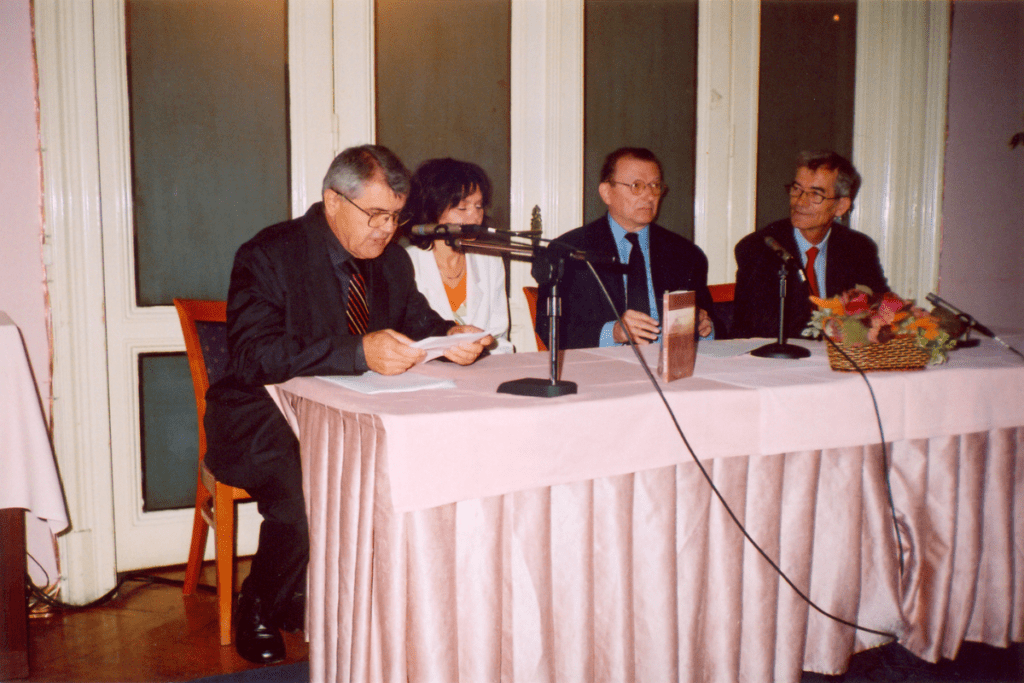
From Šaravanja’s literary legacy, the following stand out for their stylistic beauty: the collection of poems Svaka rijeka svome moru teče (Sydney, 1993); the poem Hrvatska sloboda (Sydney, 1994); and the historical monographs Hrvati sa Snježnih planina (Sydney, 1999), The Snowy and Croatians (Sydney, 1999) – which are also housed in Mitchell’s State Library in Sydney. The exiled prose writer and poet Šaravanja has also been included in prestigious anthologies: Hrvatska iseljenička lirika (1974) edited by Fr. Lucijan Kordić; Herzegovina (2002) edited by Dr. Vjekoslav Boban; and a bilingual collection of short stories by Croatian writers in Australia, Zrcala u sjeni; zbornik pripovijetki australskih pisaca Writers’ Mosaic” (1992, 1993, 1996)…
He published the notable novels Idemo kući, Na drugoj strani vremena, Gelipter and Novo odijelo. For his first novel, Idemo kući, he received the Fra Lucijan Kordić Award for the best work thematically dealing with the lives of Croats outside the Republic of Croatia. Šaravanja continued to develop an autobiographical discourse in his other novels. Thus, for the six-hundred-page novel Na drugoj strani vremena, he won the Passion Heritage Award and the Croatian Writers’ Association Award from Zagreb. This novel will be remembered as a fascinating saga about two families from the same place who, despite different political worldviews, end up in the diaspora. It is not just a description of the many exile-related complications: this work is a testimony to a life and a turbulent historical period after the mid-20th century, the likes of which have never before been written in Croatian literature. This novel by Šaravanja follows the life journey of a man who goes from being a bright village boy to becoming a prominent citizen of Australia, placing its author among the anthological prose writers. Few books in Croatian literature authentically testify to the national reconciliation of all Croats and the deep connection between the diaspora and homeland Croatia. Draga Šaravanja’s literary works have been included in several anthologies of Croatian and diaspora literature in Australia, Croatia, and Bosnia and Herzegovina.
Employees of the Croatian Heritage Foundation express their deep condolences to the Šaravanja family in Croatia and Australia.
May he rest in God’s peace.
The funeral will be held at Mirogoj on Monday, August 31, 2026, at 11:40 a.m.
Text: Vesna Kukavica


