Eduard R. Antonich has dedicated his work, co-published in Zagreb by AGM and the Croatian Heritage Foundation, to his grandfather and grandmother Maks and Marija, from whom he gained his love of Croatia.
Eduard R. Antonich’s Hrvatska i Hrvati u Urugvaju (“Croatia and Croatians in Uruguay”) was recently co-published in Zagreb by AGM and the Croatian Heritage Foundation. The foreword was penned jointly by CHF director Mijo Marić and AGM director Stjepan Bekavac. Antonich’s original history, Croacia y los croatas en Uruguay, was published fifteen years ago and has now seen its deserved Croatian language translation, richly illustrated with previously unpublished photography by one of the pioneers of photography among our diaspora communities Srećko Dumić. This monograph is published as part of AGM’s prestigious Res Gestae series and has been translated from Spanish by Željka Lovrenčić. The book presents seventeen chapters and makes a significant contribution to our understanding of the many decades over which Croatian immigrants lived and worked in Uruguay and to shedding the ideological stigma the local Croatian diaspora acquired during the turbulent twentieth century. Today the country is home to some five thousand people of Croatian extraction. Writer and jurist Antonich offers a judicious reading of Croatian history in the modern period in its global context, in particular the history of diaspora activity aimed at resolving the “Croatian question” and how this impacted the people of Croatian ancestry in the countries of South America in the period from 1918 to 1991. Antonich presents a comprehensible overview of the cultural heritage of the earliest Croatian immigrants in Uruguay, in particular the periodicals they published and the archival material of Croatian heritage organisations in the country, while in terms of the global and critical historical processes his focus is on the events in the political theatre in Croatia over the course of the twentieth century, and on the challenges faced by our nation in the most recent past in the wake of the ultimate collapse of political communism in Europe in 1989.
In this regard Antonich’s chapters point to the core themes of the book: 1) In the Footsteps of the Pioneers; 2) Emigration and Uruguay as a Destination; 3) From the Creation of a Kingdom of Serbs, Croats and Slovenes to the Assassination in the Parliament; 4) The Death of Stjepan Radić and the Founding of a Croatian House in Montevideo; 5) The Home Guard and the Presence of Adherents of the Ustasha Regime in Uruguay; 6) Pro-Yugoslav Croatians: The Bratstvo Culture Association of Yugoslav Immigrants; 7) The Institutionalization of Religious Activity: The Formation of Croatian Catholic Communities; 8) Serbian Dictatorship under the Yugoslav King Aleksandar and the Suffering of the Croatian People; 9) The View of the [Second World War] NDH Regime from Uruguay; 10) Croatian Immigrants and their “Old Country”; 11) Mutual Aid and Contributions to the Homeland; 12) Social, Cultural, and Sporting Activity Among the Croatian Communities in Uruguay; 13) The Informbiro [Cominform: Communist Information Bureau] Crisis: The Fallout from the Breakdown of Ties Between Tito and Stalin; 14) Ethnic Croatian Press and Radio in Uruguay; 15) Stalking Diplomacy; 16) Networking Among Croatian Associations in Uruguay: The Long and Winding Path Towards Understanding; and 17) From ‘Brotherhood and Unity’ to Croatian Independence.
Having studied the available sources, from the first Croatian to settle in Uruguay: Brač island native Šimun Matulić, to the present in domestic and foreign archives, Antonich presents an unbiased work of history the style of which is characterised by a happy combination of scholarly rigour and publicist discourse, endeavouring to find in the testimony of people that have relocated to other countries the motivations upon which he builds his findings and to speak to the peak period of emigration to Uruguay from Europe (beginning in the 1880s) during the early period of industrialisation through to the emergence of globalisation on the basis of documentation. The author has thus applied a balanced methodology that looks with equal curiosity at the characteristics of major historical episodes and the role at the time of the South American labour market as it related to impoverished Croatian peasants, labourers and mariners who were moving out of Croatian lands (primarily Croatia’s southern coastal regions) and heading for the Americas, always with the elusive intention of returning some day with much improved personal finances to their native land. The author observes that the greatest influx of Croatians to Uruguay occurred in the period following the First World War, more precisely between 1924 and 1936.
Antonich studiously follows the fate of Croatian migrant workers over a period just short of a hundred years, interpreting the phases of the resolution of the “Croatian question” in the late stage of the second millennium, during Croatia’s time in the fold of the Austria-Hungary dual monarchy and the first and second Yugoslav regimes, the factors that motivated support of the “Yugoslav” concept as a political tool (Supilo, Trumbić and others), support among the diaspora for gradual Croatian national integration, and the process in the 1990s of restoring to the Croatian fold the diaspora communities comprised of people whose descendants had long ago moved out of their native land when its sovereignty was at best incomplete and when it was not numbered among the states on the map of the world. The chapters are complemented by exhaustive notes, illustrated with copies of original documents (of the almost five thousand examined by Antonich) that bring us closer to the Croatian diaspora in South America, where the third and fourth generation descendants of Croatians that moved to the country are applying themselves through hard work and higher education to rapidly climb the social ladder in Uruguay. The author also points to the leading figures in the political and cultural scene of the local diaspora, including the leaders of ethnic Croatian associations in Montevideo: the Croatian House civic centre, the Hrvatski Domobran association, the Bratstvo association, the ethnic Croatian Roman Catholic communities, tamburitza ensembles, radio programmes and Croatian language instruction programmes.
The period covered in what is the first proper study of the Croatian diaspora in this South American country closes with the phase that saw ethnic Croatians in Uruguay lobby for their country’s official recognition of full Croatian independence on 16 January 1992 and opens with the story of the first Croatian known to us in Uruguay, a native of Postira on the Croatian island of Brač, recorded in the archives of Uruguay as Simón Matulich. Among his grandchildren was Dr Teodor Vilardebó, the son of Matulich’s daughter and only child Martina and Miguel Antonio Vilardebó. After attending studies in Barcelona and Paris (1847) Šimun’s grandchild returned to Uruguay, taking part in providing healing during the yellow fever episode, an illness he fell victim to a decade later (1857).
The publication of this book comes as the Croatian Heritage Foundation marks it seventieth birthday and its work over the past seven decades with the ethnic Croatians of Uruguay.
In the period from 1924 to 1936 Croatians settled in the interior of Uruguay as farmers. More recent immigrants from our country settled in the capital city of Montevideo and nearby areas to work in the industrial and commercial sectors and in government jobs. They settled in places like Cochillas as stone quarry labourers, and in places like Colonia and Carmelo to work in the maritime sector, some as proprietors of ships and others of inns and restaurants. The Croatians moving abroad at the time were largely from rural areas. Some were farmers, some fishers, while most were construction labourers, later often transitioning into commerce-related lines of work.
The Croatian national idea as formulated by the Radić brothers that took hold among all strata of our society in the first half of the twentieth century, formed the roots of what could be considered a modern Croatian identity across all segments of Croatian society, including the diaspora in Uruguay. A Croatian House was founded in Montevideo on 28 April 1938 and went on to become the largest and most influential ethnic Croatian organisation in the country. In his book Antonich presents very valuable and previously unpublished facts concerning the founding of this diaspora organisation, using first hand sources (minutes of association meetings and documents of the education and culture ministry).
The shocking murder in 1928 by a Serbian MP on the floor of the Yugoslav parliament of Croatian deputies, including the mortal wounding of Croatian Member of Parliament and Peasant Party leader Stjepan Radić, became the focal point of the unity, membership and work of the organisation. Radić was a guiding light and an example of upstanding virtue.
It was many years later, in 1989, that Franjo Tuđman’s HDZ party brought new hope for Croatian freedom in the homeland, with his party quickly morphing into a national movement, both at home and abroad, aimed at full Croatian independence. Chapters of the HDZ party sprang up wherever major ethnic Croatian communities had settled around the world, including a chapter in Montevideo, founded in 1990. The party chapter worked with other ethnic Croatian groups in the country to lobby then Uruguayan foreign minister Héctor Gros Espiell to recognise Croatia’s independence. In 1991 the local Croatian House withdrew from the coordinating committee of “Yugoslav” institutions and moved to work more closely with the local Croatian Catholic Community organisation. Both groups hosted faith-based, cultural and humanitarian events aimed at collecting aid for the families of those who fell during the Homeland War in defence of the country’s nascent independence.
The diaspora community in Uruguay played an important role both in terms of material aid and moral support for their ancestral homeland, with some joining the effort as volunteers in the fledgling armed forces. In her review Marina Perić Kaselj notes that “In this book, in the example of the Croatian diaspora community in Uruguay, we see the dynamic nature of ethnic identity, always given to redefinition. Through this history of the diaspora community the author delves into the various forms of collective identification among the diaspora community members—Slav/Croat, Yugoslav—and how these appellations complemented one another. For people of Croatian ethnic background in the diaspora identifying as Yugoslav or Croat was contingent on an evolving situation. The [political] ethnic identification of these emigrants was directly impacted by the socio-political situation in the country of origin and the manner in which it was presented and comprehended by the leading figures in the Croatian diaspora. From the founding of the local Croatian House the political concept forged by Stjepan Radić was the dominant position informing diaspora alignment in Uruguay. In spite of the adoption of the Yugoslav option and the legitimisation of the Yugoslav regime among the diaspora, in particular among the members of the Croatian House organisation, even after the Second World War the idea of identifying as Croatian and Yugoslav was not seen as mutually exclusive, but rather as a set of cumulative categories. As we learn in this book the Homeland War period and the time that followed the declaration of Croatian independence and its reinstated statehood saw [exclusively] Croatian ethnic alignment on the upsurge, with the diaspora community in Uruguay now fully identifying as [ethnic] Croatian. This book offers new insight and opens new horizons and constitutes a major contribution to the further study of the history of the Croatian diaspora community in Uruguay,” concludes Ms Perić Kaselj in her review, recommending the book to specialist and layman alike, from researchers to the broader readership.
Eduardo R. Antonich was born in Montevideo in 1963. He earned his degree at the Universidad de la República in law and social science in 1990 and has pursued a successful career as an attorney. Since 2003 he has served as the Croatian honorary consul in Uruguay.
On his father’s side he is the grandchild of immigrants who moved to Uruguay in 1925 from Bribir, a village on the northern Croatian seaboard. He has been active in the local ethnic Croatian community since his childhood, participating in the social and cultural activities of the Bratstvo, Naša Domovina and Hogar Croata organisations in Montevideo. He has been a member of the Hogar Croata (“Croatian House”) organisation for almost forty years, since 1984, sitting on its management board since 1988. Antonich is also active on a local Croatian language radio show and in other community activities. In 1987 he took advantage of a Croatian Heritage Foundation study grant to visit Zagreb to learn the Croatian language and study our folklore. He is married to Milka Kršul Musa, herself the granddaughter of Croatian immigrants. Their son Ivo has inherited their love for his ancestors’ country of origin and in 2019 he attended the University School of Croatian Language and Culture organised by the Croatian Heritage Foundation. He has lectured at home and abroad at symposia and conferences on the history and cultural aspects of European migration, with particular focus on the challenges posed by outbound migration from Croatia.
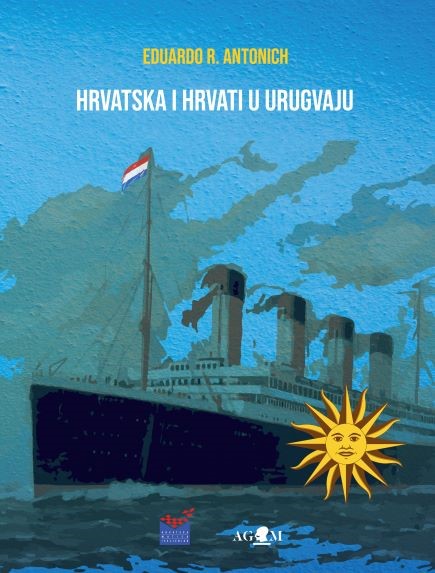
Among the many events described in this book are some unsettling, but also encouraging anecdotes concerning some of the folks, impoverished peasants, that moved abroad. One such event, described on page 68, is featured in the cover art. This was the wreck of the Princippessa Mafalda, survived by eleven Croatians travelling from the village of Vela Luka who later settled in the Uruguayan capital of Montevideo. The trip from Europe into the unknown, taking them to South America, meant so much for impoverished people leaving Croatia, and is symbolised by the bright sun on the Uruguayan flag. This optimistic solar symbolism and the blue of the ocean sailed by a steamship plying the waters from Europe to the Americas with the historic Croatian tricolour at the stern is certainly memorable cover art created by publisher AGM.
By: Vesna Kukavica
Photography: Archive of Hogar Croata, Montevideo