


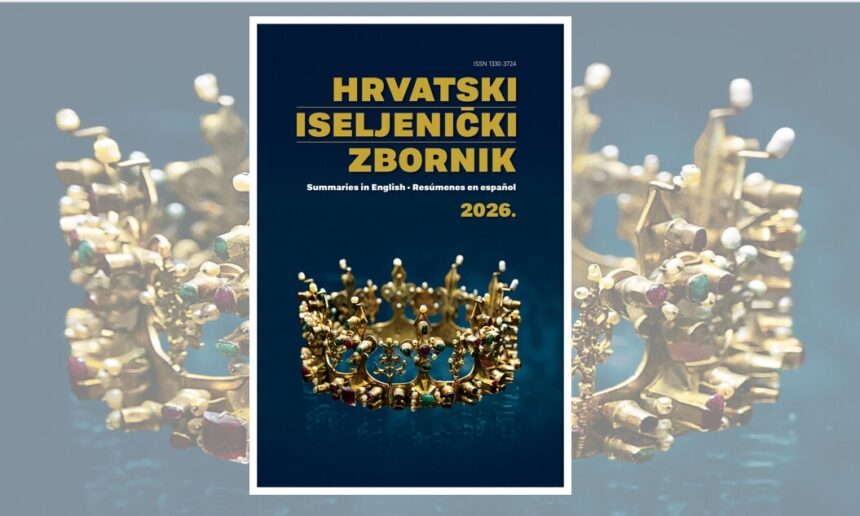
The Almanac, spanning 404 pages, presents the results of the research on our external migrations and the cultural achievements of our dispersed Croatian citizens.
The new 2026 Croatian Emigrant Almanac was published recently. In six thematic units entitled Signs of the Times, Croatian Philological Horizons, Bridges, History, Science and New Books, the Almanac brings 29 diverse and richly illustrated contributions by authors. Although it developed from the tradition of the most widely read Revival calendar periodicals, Matica’s Croatian Emigrant Almanac has, in the Internet era, transformed into a completely modern media format that covers the contemporary Croatian cultural community at the global level. It is a popular scholarly publication in which a group of selected Croatian language experts, linguists, ethnologists and art historians, sociologists and historians covered the selected work of Croats outside the Republic of Croatia through the past and present, including recent intercultural events involving people of Croatian origin in 25 countries from around the world. The Almanac, spanning 404 pages, presents the results of research on our external migrations and the cultural achievements of our dispersed Croatian citizens, from America to Australia and to the nearby Croatian neighborhood.
Fragments of Contemporary Emigrant Creativity
By reading this year’s CHF Almanac, you will find out who is the greatest philanthropist among the Croats of South America, as well as who is the most skilled Croatian mathematician involved in the development of AI algorithms and applications for artificial intelligence applications; who are the prominent promoters of knowledge transfer between Croatian university institutions and international laboratories from Toronto, Santa Barbara and Cambridge to Split, Rijeka and Zagreb. As the visual medium dominates our lives today, by reading the Matica Almanac, you will find out who is the first Croatian artist in America whose designs are built into the foundations of the Croatian-American print media, and who has managed to shape an attractive visual identity and implement contemporary aspirations towards Croatian national expression, including adapted folk motifs from his homeland to the American environment; what is hidden in the heritage treasury of the Croatian Fraternal Union in Pittsburgh and what is currently being digitized to make this ethnomusicological and archival material of invaluable cultural importance available to the widest public on both sides of the border; who is the humble priest from the island of Krk among the founders of the Croatian Academy of America, which has been publishing the most widely read English-language journal of Croatia history and culture for decades, the Journal of Croatian Studies; what influential Croatian association from Australia is celebrating its 75th birthday and with what program goals does it continue to operate in the multicultural environment of the developed society in Australia. Screening crime novels is quite attractive to global readers and viewers, and in this genre, Croats in Chile have a heavyweight presence in favorite crime novels and in TV series watched in the Hispanic world. When it come to reading and writing – in the 71st year of publication, the new Croatian Emigrant Almanac pays special attention to learning and teaching in speaking and writing of the Croatian language, history and culture of Generation Z. This topic was addressed by the top experts of our Croatian language, linguistics and foreign Croatica, so you will read in the Almanac about language technologies and online courses of our mother tongue, about onomastics among Croats (and the commemorative 1,100th anniversary of the Croatian Kingdom) and the frequent use of the personal name Tomislav; the effective achievements of investments in education on the part of the Central State Office for Croats Abroad; online games for learning the Glagolitic alphabet in an entertaining and interactive way; ventures in the artistic creativity of children from multilingual backgrounds and their teachers from Croatian classes in Switzerland and the astonishing achievements of the longest-running Matica academic language program, the University School of Croatian Language and Culture, whose participants have unquestionably contributed to the affirmation of the Croatian language and culture in the native societies of our emigrants, from Alaska to Tierra del Fuego, from the south of Africa to Australia and New Zealand, including the countries of the Old Continent all the way from Scandinavia to the closer neighborhood, where the Croatian minority has been living in 12 European countries for over half a millennium.
Impressive is the ethnographic record of the island of Susak and its dispersed enclave in New Jersey, which is renewed every summer in its Mediterranean cradle, respecting, on the one hand, the indigenous island population in this Adriatic ecological oasis and, on the other hand, foreigners. As part of the Intangible Cultural Heritage of Croats in Serbia series, an interesting book, Bunjevačke kraljice: Duhovski običaj bunjevačkih Hrvata was published, whose extensive review was published in Matica’s new Almanac, as it was not too well known outside narrow professional circles that spiritual spring processions are also practiced outside the Republic of Croatia, and especially that they are also practiced by Bunjevac Croats. The Almanac also highlights recent eco-linguistic research and sociological analyses of the revitalization of the identities of the Molise and Moravian Croats, based on fieldwork by younger experts from Italy and the Czech Republic, with involvement from researchers in their home countries. The 60th anniversary of pastoral care for Croats abroad is an occasion to include, in the CHF’s Almanac, an extensive record and to show gratitude to the spiritual and cultural contributions of our priests, nuns and pastoral workers to the lives of believers in the domicile destinations of the Croatian diaspora, who number in the millions.
Knowledge Transfer and Sustainable Return
In summary form, along with the recent foreign cultural creativity of people of Croatian origin and the transfer of knowledge from the diaspora to the homeland, the central topic of the new Almanac is the sustainable return of emigrants, so “Measures for the Return Migration, Integration and Employment of Croatian Emigrants and Descendants of Croatian Emigrants from South America” and the thoughts of potential returnees of the younger Croatian community from the German federal province of Bavaria, which is currently inhabited by more than 130,000 Croats. In addition to preserving identity, diaspora communities – such as our community in Bavaria – also contribute to their homeland through remittances, knowledge transfer, international influence, investment attraction, and serving as a source of demographic potential. The confirmation of the latter in the context of the Croats in South America and Bavaria (i.e., Germany) lies in their age composition, which is significantly younger and more favorable than that of the population of Croatia. Consequently, Croats from South American countries are of significant importance to Croatia, as they serve as a cultural, economic, and political bridge between the homeland and the world, establishing themselves as a key factor in shaping the transnational Croatian reality. The results of research conducted by experts from the Institute for Migration and Ethnic Studies and the Faculty of Croatian Studies, and their partners, indicate a strong interest among Croats abroad in returning to and working in Croatia, especially among the younger, highly educated population. The researchers remark that the contribution of return migrants from South America to the Republic of Croatia is reflected in their multicultural capital, since the descendants of Croats bring knowledge of Latin American cultures of the Spanish and Portuguese-speaking countries, economic and social practices from these distant meridians, which could help Croatia open up to the developed markets outside of Europe. Return migration of descendants of Croatian emigrants from the countries of South America, whose number is estimated at about half a million people, is one of the priorities of the 2030 National Development Strategy of the Republic of Croatia, which generally considers return from the diaspora among the important measures of demographic renewal and social development of the Republic of Croatia.
Authors of the 2026 CHF Almanac
In conclusion, the papers published in the new volume of the CHF Almanac are authored by experts, including doctorate-holders Jasna Čapo, Tatjana Mihalić, Marina Perić Kaselj, Natasha Kathleen Ružić, Jasenka Ferber Bogdan, Sanja Žaja Vrbica, Monika Balija, Tamara Bodor, as well as historians and doctorate-holders Ivan Tepeš, Wolfy Krašić, Ivan Hrstić, Božo Skoko, Stan Granic, and Croatian language experts and doctorate-holders Milan Bošnjak, Vedran Iskra, Domagoj Vidović, Josip Mihaljević, Hispanists and doctorate-holders Željka Lovrenčić, Marta Tomić, English language experts Walter Vori Lalich, Ivana Bašić and Darko Perić, German language experts Manuela Obad, Sara Marđetko, demographers Marijana Komljenović, and reliable permanent associates such as award-winning science journalist Tanja Rudež, Dubravko Barač, Đuro Vidmarović, Marijeta Rajković Iveta, Lada Kanajet Šimić, Snježana Radoš and Vesna Kukavica, editor of this popular serial publication on the contemporary mobility of Croats. Finally, the cover of the Almanac is adorned by the Croatian crown, an artifact from the middle of the 14th century from the current monumental exhibition at the Klovićevi Dvori Gallery, organized on the occasion of the 1,100 anniversary of the Croatian Kingdom.
From the History of the CHF Almanac
The serial publication The Emigrant Calendar (today’s Croatian Emigrant Almanac) was launched 71 years ago, in 1955, to be precise. The Croatian Emigrant Almanac usually publishes about thirty contributions annually. Modern migration has been recognized as a challenging economic and cultural category – as evidenced by references to articles from a network of some 300 associates, as well as a serial publication that has reached more than 35,000 pages in the digital repository.
The CHF Almanac provides plenty of current views of prominent domestic and foreign authors and publicists, strong artistic and scientific personalities, as well as insights into the unique destinies of regular, ordinary emigrants. The CHF Almanac equally follows those people who chose travel as a lifestyle, migrants of various provenances in global labor markets, up to the generation of Croatian descendants who have established themselves in cultures from Alaska to Tierra del Fuego, the south of Africa, Australia and New Zealand, as well as those who have found their new home throughout the Old Continent. The Croatian Emigrant Almanac nurtures the full thematic and disciplinary openness of the modern age, at a time when every 35th inhabitant of the Earth is an international migrant.
The promotion of the Croatian Emigrant Almanac was held exactly on the birthday of its publisher, on Thursday, February 12, as part of the Gala Assembly on the occasion of the 75th anniversary of the Croatian Heritage Foundation’s establishment.
Browse the electronic edition of the 2026 Croatian Emigrant Almanac at the following link:
https://hit.repozitorij.ffzg.unizg.hr/object/hit:407
Text: Snježana Radoš / Photo: Cover of 2026 CHF Almanac-CHF Archive/Klovićevi Dvori Gallery/HINA 


