


Valuable archives of Josip Gujaš Đuretin were submitted to Croatian institutions in Hungary for safekeeping.
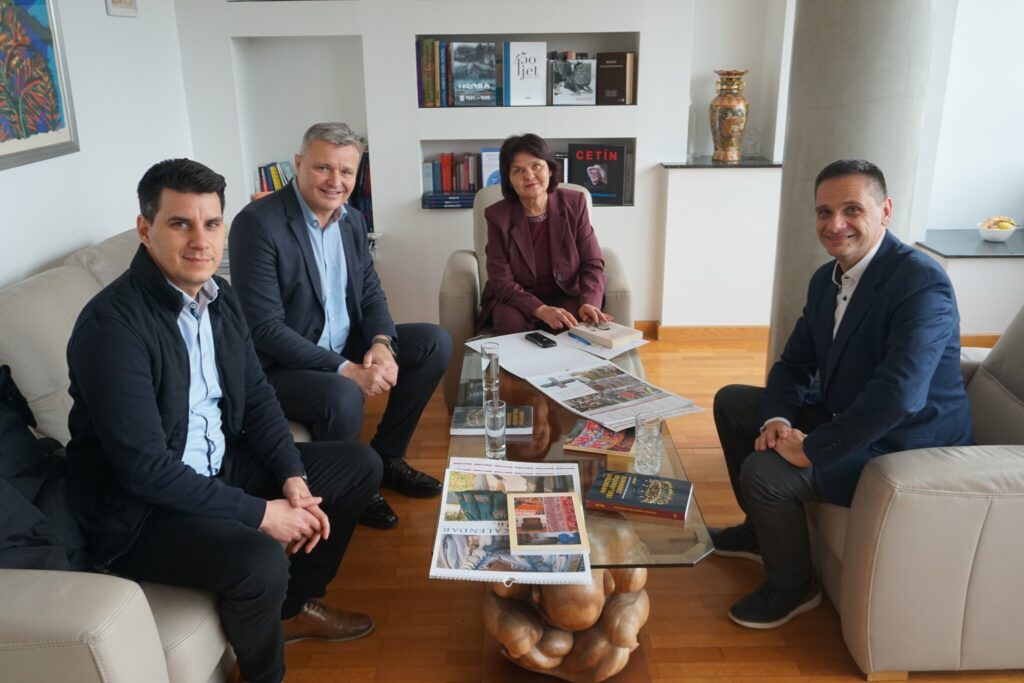
On October 2, the Director of the Croatian Heritage Foundation, Zdeslav Milas, held a working meeting with the President of the Croatian State Self-Governing Body from Hungary, Ivan Gugan, and the representative of the Scientific Institute of Croats in Hungary, Silvester Balić, Ph.D. in the presence of literary historian Đuro Vidmarović, M.Sc., member of the Croatian Heritage Foundation’s Management Board. The guests from Hungary informed Director Milas about the current cultural activities of the Croatian minority in Hungary and presented him with the latest regular editions of the Naklada Croatica publishing house in Budapest. Director Milas wished the guests much success in their future activities and exchanged with them copies of the new issues of the monthly “Matica” and the annual “Croatian Emigrant Almanac”.
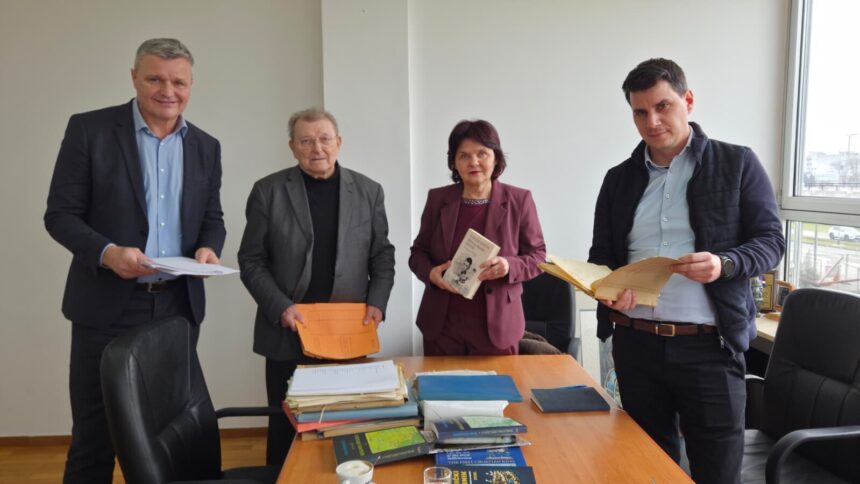
The main reason for the working meeting on February 3 in the premises of the Croatian Heritage Foundation was the donation of the writer and historian Đuro Vidmarović’s entire archives on the famous poet and scholar from Hungary Josip Gujaš Đuretin, to the Croatian State Self-Governing Body, the Scientific Institute of Croats in Hungary and the Josip Gujaš Đuretin Cultural and Sports Center, which will open a memorial collection in Pécs this year, during Đuretin’s important anniversary celebrations. The working meeting on the occasion of the donation of the literary and archival material about Đuretin was also attended by the head of the CHF’s Publishing Department, Vesna Kukavica.
As a reminder, the literary historian Vidmarović possesses valuable archival materials and manuscripts of Đuretin, as he prepared the collected works of Josip Gujaš Đuretin, “Mene su ljepote ostavile”, which was published in 2019 by the publisher in Zagreb, Acumen d.o.o., with the CHF as co-publisher. For four decades, Đuro Vidmarović explored the life’s work of the poet and scientific analyst of the social phenomena of the Croats in Hungary, a professor at a Budapest secondary school, resulting in an extensive book titled after a verse from one of his last poems. In the book, Vidmarović divided Đuretin’s collected works into two parts. In the first, Vidmarović analyzes, at the literary and theoretical level, Gujaš’s lesser-known poetic legacy and academic interests related to his own minority identity, as presented in Đuretin’s doctoral dissertation. Worthy of mention is Đuretin’s cooperation with the writer from his home country, Milivoj Slaviček, and the archival and philological material provided to the organizer by Gujaš’s late wife, Vera Grunčić. Now, thanks to Đuro Vidmarović, this valuable archival material of great philological importance will be arranged and museologically processed and permanently exhibited to the general public in the Cultural and Sports Center bearing the famous poet’s name, as promised by President Ivan Gugan and literary theorist Silvedstar Balić, Ph.D. from Pécs.
The archival material donated by Đuro Vidmarović and the book of collected works by Josip Gujaš Đuretin (1936 – 1976) will be presented to the public in Hungary in memory of the poet’s 90th birthday and on the occasion of the 50th anniversary of his untimely death. In this manner, the memory of the life and work of this Croatian intellectual born in 1936 in Gornji Martinci will be permanently preserved. Đuretin is actually a family nickname, received after the grandfather’s name Đuro, Đureta. At the time, the poet Gujaš was studying in Szeged, then in Pécs, and finally in Pest: a double major – history and the Croatian language with Yugoslav literatures. He graduated in 1961 and, at the age of 29, he obtained his doctorate from the University of Budapest with his dissertation “The Politics of Violent Assimilation in Europe and Hungary (Magyarization in the Counties of Somogy and Zala — Međimurje) and the National Defense of Hungarians in Slavonia during Dualism”. He is remembered as an excellent professor at the Croatian-Serbian Secondary School in Budapest. However, he became seriously ill and, as a result, had to retire in 1971. He passed away very sick, poor and out of work at the age of forty.
Significant gratitude goes to the donor of the collected archival and literary-philological material, and to the organizer and literary historian Đuro Vidmarović, who is an excellent connoisseur of the literary achievements of the Croatian national minority in the European neighborhood. “In terms of talent, poetic sensibility and especially literary education, Gujaš distinguished himself from other national poets. Through his work, he became a leader in the struggle for the acceptance of contemporary literary trends, for complete autonomy of literary work, and for writing without fear and limitations. He was aware that national poetry was stagnating in some of its historical cocoons, that it was lagging behind the contemporary trends of both Hungarian and (at the time) Yugoslav poetry,” explained to us the literary historian and donor Đuro Vidmarović. Furthermore, literary theorists of the Croats in Hungary consider Đuretin’s poetry to be the most significant phenomenon from 1918 to the present. In the anthology of Croatian poetry “U kolo”, published six decades ago in Hungary, Đuretin is represented by 24 poems, most of which are included in Gujaš’s posthumously published collection of poems “Povratak u Podravinu” (Return to Podravina) (1977), which was the first published book in the literature of Croats in Hungary. It should be noted that this donation and the collection of works by Đuretin are the culmination of self-directed efforts to incorporate the scattered European heritage of Croatian provenance into our literature.
Text: Vesna Kukavica / Photo: Željka Sablić Odrljin


